Your Water Isn't Neutral: A No-Math Guide to pH, Hardness, and Why Your Tap Water Is Already Telling You What Fish to Keep
If you've ever Googled "aquarium water chemistry" and immediately closed the tab because it looked like a college exam, you're not alone. Between pH scales, carbonate hardness, general hardness, alkalinity, and buffering capacity, it can feel like you need a chemistry degree just to keep a goldfish alive.
Here's the good news: you don't. You really don't. The core concepts behind aquarium water chemistry are actually pretty intuitive once you strip away the jargon, and understanding them practically — not mathematically — will make you a significantly better fishkeeper.
Let's start from scratch.
What pH Actually Means for Your Fish (Not for Your Test Kit)
pH measures how acidic or alkaline your water is on a scale from 0 to 14. Seven is the midpoint — "neutral." Below 7 is acidic. Above 7 is alkaline (sometimes called basic). Most freshwater fish do best somewhere in the 6.5 to 7.8 range, but that wide window hides a lot of important variation.
Here's the thing most beginners don't realize: fish don't care about the number on your test kit. What they care about is whether the pH is stable and whether it matches the water they evolved in.
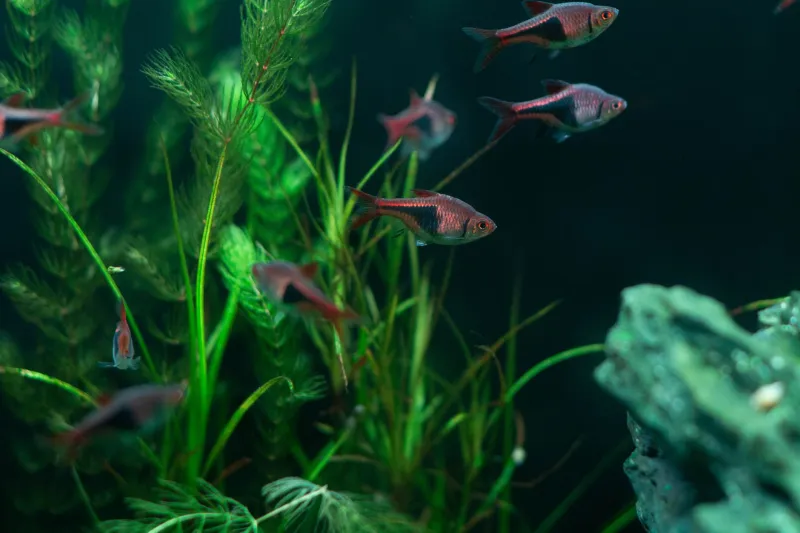
A fish from the Amazon basin — like a cardinal tetra or a discus — comes from soft, acidic water that might sit around pH 5.5 to 6.5. A cichlid from Lake Malawi in Africa evolved in water that can hit pH 8.5. Neither fish is "wrong" for preferring what it prefers. They're just adapted to very different chemical environments.
Put a cardinal tetra in hard, alkaline water and it'll probably survive. But its mucus membranes, gill function, and osmoregulation — the processes that let it manage salt and water balance internally — are all working harder than they should be. That chronic physiological effort is stress, and stress opens the door to disease.
Why pH Swings Are More Dangerous Than pH "Wrong Numbers"
This is the part of pH that doesn't get enough attention. A fish living at a stable pH of 7.8 is almost always healthier than a fish whose tank swings between 7.0 and 8.0 throughout the day.
Why do tanks swing? A few common reasons:
- CO2 fluctuation. Plants and algae consume CO2 during the day (raising pH) and release it at night (lowering pH). In heavily planted tanks without CO2 injection, this daily swing can be dramatic.
- Low buffering capacity. This is where KH comes in — more on that in a moment.
- Overcrowding and overfeeding. Organic decay produces acids. A heavily stocked, overfed tank will see pH drop over time, especially between water changes.
If your fish look fine in the morning and lethargic by evening, a pH swing is one of the first things worth investigating.
KH: Your Water's Shock Absorber
KH stands for carbonate hardness, and it's the parameter most beginners have never heard of — which is a shame, because it's arguably the most important one for tank stability.
Think of KH as your water's ability to resist pH changes. High KH means your water is well-buffered: you can add acid or alkaline substances and the pH barely budges. Low KH means your water is poorly buffered: small changes in CO2, organic acids, or mineral content can send your pH on a rollercoaster.
In practical terms: if you have soft, low-KH tap water (common in the Pacific Northwest, parts of New England, and some areas of the Southeast), your tank pH is vulnerable. Without attention to buffering, it'll drift downward over time, especially in established tanks where organic acids accumulate.
If you have hard, high-KH tap water (common throughout the Midwest, Texas, and the Southwest), your pH is rock-solid stable — sometimes stubbornly so. Trying to lower the pH of heavily buffered water is like trying to push against a locked door.
GH: The Mineral Content Your Fish Actually Feel
GH — general hardness — measures the total concentration of dissolved minerals in your water, primarily calcium and magnesium. This is the "hard water vs. soft water" distinction you've probably heard about.
Hard water feels slippery in the shower, leaves deposits on your faucets, and is the reason coffee tastes different depending on where in the country you make it. Soft water is the opposite — low mineral content, which is why cities like Seattle and Portland are famous for their coffee and brewing scenes.
For fish, GH matters because those dissolved minerals directly affect the osmotic balance between the fish's body and the surrounding water. Fish from soft-water environments have evolved to function with very little mineral gradient across their tissues. Put them in hard water, and their kidneys and gills are working overtime.
Conversely, fish from hard-water environments — African cichlids, livebearers like guppies and platies, most goldfish — genuinely need that mineral content to maintain healthy gill function, bone density, and overall physiology.
What's Coming Out of Your Tap Right Now
Here's a genuinely useful piece of information that most beginners never look up: your municipal water utility is required by federal law to publish annual water quality reports. These reports include the hardness and pH of your tap water. You can find yours by searching "[your city] water quality report" or visiting your utility's website.
This matters because your tap water is your baseline. Everything you do in your tank starts from there.
If you're in the Midwest or Southwest (think Denver, Phoenix, Dallas, Chicago), you're almost certainly dealing with hard, alkaline water — high GH, high KH, pH above 7.5. This is perfect for livebearers, African cichlids, goldfish, and most Central American cichlid species. It's a real challenge for soft-water Amazonian fish.
If you're in the Pacific Northwest or New England (Seattle, Portland, Boston), your tap water is likely very soft and slightly acidic — low GH, low KH, pH around 6.5 to 7.2. Great for tetras, rasboras, discus, and most Southeast Asian species. Hard-water fish will need supplementation.
If you're in Florida or the Gulf Coast, you may have naturally hard water from limestone aquifers, or you may have treated municipal water that varies significantly by county. Worth checking specifically.
If you're on well water, all bets are off — well water chemistry varies enormously by geology and can include iron, sulfur, and other compounds that municipal systems filter out. A full water test is essential before you set up any tank.
Working With Your Water Instead of Against It
The single most practical piece of advice for any new aquarist: stock fish that match your tap water, not fish you have to constantly adjust your tap water for.
If your water is hard and alkaline, lean into it. African cichlids are some of the most colorful, behaviorally interesting fish in the hobby. Livebearers are hardy, active, and breed readily. Goldfish are genuinely fascinating animals with decades-long lifespans when properly kept.
If your water is soft and acidic, you have a natural advantage with some of the most sought-after fish in the hobby — cardinal tetras, German blue rams, chocolate gouramis, and even discus if you're up for the challenge.
When you do need to adjust — and sometimes you will — here are the safest, most reliable approaches:
- To soften hard water: Mix with RO (reverse osmosis) water, available at most fish stores and many grocery stores. A 50/50 blend often hits a useful middle ground.
- To harden soft water: Add crushed coral or aragonite to your filter or substrate. It dissolves slowly and raises both GH and KH naturally.
- To stabilize pH in a low-KH tank: Add baking soda in very small amounts, or use a commercial buffer product. Never make large adjustments at once.
- To lower pH in a high-KH tank: This is genuinely difficult without RO water. Chemical pH-down products are a temporary fix that can cause dangerous swings. RO blending is the sustainable solution.
The One Thing to Remember
If you take nothing else from this guide, take this: stable beats perfect, every single time. A fish living in water that's slightly outside its ideal range but rock-solid stable will outlive a fish in "perfect" water that swings by a full pH point each day.
Understand your water, choose fish that fit it, and adjust gradually when you need to. That's the whole game.