Flow Check: Matching Your Filter to Your Tank Instead of Just Buying the Biggest One on the Shelf

Photo by Photo by DANIEL JONES on Unsplash on Unsplash
If you've spent any time on aquarium forums or in Facebook groups, you've seen it: someone posts about a new tank setup, and within minutes the comments are full of "go bigger on the filter" and "you can never over-filter." It's practically gospel in the hobby. And like a lot of gospel, it contains a kernel of truth wrapped in a layer of oversimplification that can genuinely lead you astray.
The reality is that filtration isn't a category where more is automatically better. It's a system that needs to match your specific tank — the species you're keeping, the plants you're growing, the water volume you're working with, and the bioload you're actually generating. Get that match right, and your filter runs quietly in the background doing exactly what it needs to do. Get it wrong in either direction, and you'll be troubleshooting problems that seem unrelated to your filter but trace back to it every time.
What Turnover Rate Actually Means
The standard recommendation you'll see everywhere is to turn over your tank's full water volume four to ten times per hour. A 40-gallon tank, by that logic, needs a filter rated for 160 to 400 gallons per hour. Simple enough — except that number doesn't account for what's living in the tank.
Turnover rate recommendations were largely developed around fish-only setups with moderate to heavy bioloads. They assume a certain level of waste production, a certain density of livestock, and a certain tolerance for water movement. Apply those numbers to a low-tech planted tank with a few slow-moving fish, and you've got a very different situation.
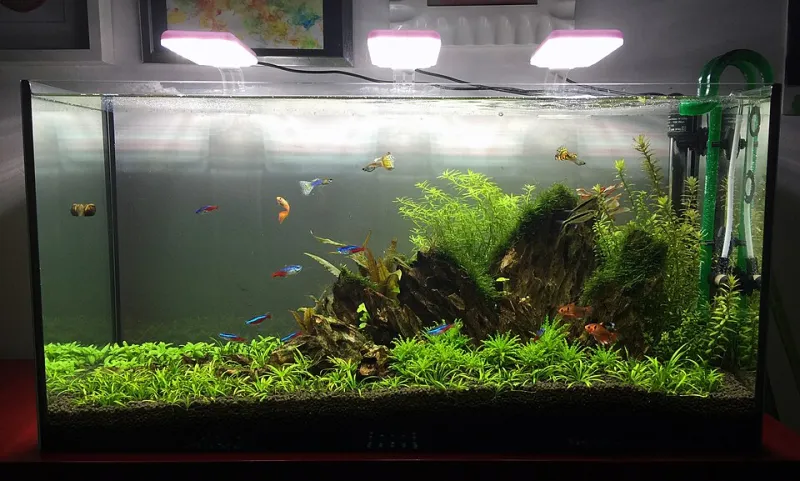
High flow in a planted tank can create problems that undermine your whole setup. CO2 — whether injected or naturally produced — gets driven off at the surface faster when surface agitation is high. Stem plants get buffeted and uprooted. Carpeting plants struggle to establish root systems when there's a constant current pushing against them. And fish that come from still or slow-moving water — think bettas, chocolate gouramis, sparkling gouramis, many wild-type betta species popular in the US hobby — can exhaust themselves fighting current that never stops.
The Hidden Cost of Oversized Filtration
Beyond flow rate, there are a few other ways an oversized filter can work against you.
Biological filtration mismatch. A filter rated for a much larger tank than you have will colonize with far more beneficial bacteria than your bioload can feed. This sounds fine until you realize that a bacterial population too large for its food supply can become unstable — crashing partially when bioload drops, then spiking ammonia briefly as it recalibrates. It's not a common cause of tank crashes, but it's a real one.
Dead zones and flow patterns. A powerful filter in a smaller tank can create strong flow in some areas and near-stagnant pockets in others, depending on the layout. Those dead zones accumulate detritus and can develop anaerobic conditions that produce hydrogen sulfide — a problem you really don't want in a planted substrate.
Noise and vibration. This is a practical one that gets overlooked: a canister or HOB filter running well above its ideal capacity for your tank size is often louder, vibrates more, and wears out faster than one operating within a reasonable range. You pay more upfront and more in the long run.
When Bigger Actually Is Better
To be fair to the "go bigger" camp, there are absolutely scenarios where oversizing filtration is the right call.
Heavily stocked tanks — especially those housing large cichlids, goldfish, or any fish with a reputation for significant waste production — genuinely benefit from filter capacity that exceeds the basic turnover formula. The formula assumes average bioload; Oscar tanks and goldfish ponds are not average bioload situations.
Canister filters also benefit from some headroom because media gradually clogs and reduces effective flow over time. A filter that starts at the exact minimum turnover you need will be underperforming within a few weeks of its last cleaning. Building in some buffer makes sense here.
And if you're running a sump system on a larger reef or cichlid setup, the redundancy of extra filtration capacity is valuable insurance against bioload spikes from overfeeding, a death you didn't notice, or a temporary increase in livestock.
The key is that these are specific situations — not blanket justifications for always grabbing the biggest filter on the shelf.
A Practical Sizing Framework
Here's a more useful way to think about filter selection than just multiplying your tank volume by a turnover number:
Step 1: Categorize your bioload honestly. Light bioload means a few small fish, no goldfish or large cichlids, moderate feeding. Medium means a reasonably stocked community tank with average waste producers. Heavy means large fish, high stocking density, or species known for significant waste output.
Step 2: Consider your tank type. A low-tech planted tank with slow-moving fish needs less turnover than a bare-bottom cichlid tank. A shrimp tank needs gentle flow and a pre-filter sponge over the intake to prevent losses. A high-energy community tank with fast-water species like danios or rainbow fish can handle — and may actually benefit from — more robust circulation.
Step 3: Match filter type to tank needs. Sponge filters are underrated for small, lightly stocked tanks and shrimp setups. HOB filters are versatile and easy to maintain for community tanks. Canisters shine on larger, heavily stocked tanks where media volume and biological capacity matter. Don't default to canisters just because they seem more serious.
Step 4: Check actual flow output, not just the rated GPH. Manufacturer GPH ratings are measured with no media installed and no head pressure. Once you add filter media and account for the height the water has to travel, actual output can be 20–40% lower than the listed spec. Factor that in when comparing options.
The Right Filter Is the One That Fits
None of this is an argument for under-filtering your tank. Insufficient biological filtration is a real and serious problem, and the consequences — ammonia spikes, fish stress, disease — are well documented. But the hobbyist community has overcorrected hard in the other direction, and a lot of aquarists are running equipment that's actively working against the specific tanks they've built.
Take stock of what you actually have: your fish, your plants, your water volume, and your maintenance habits. Then choose a filter that serves that specific setup — not the theoretical worst-case tank you might someday build. Your fish, your plants, and your electricity bill will all be better for it.